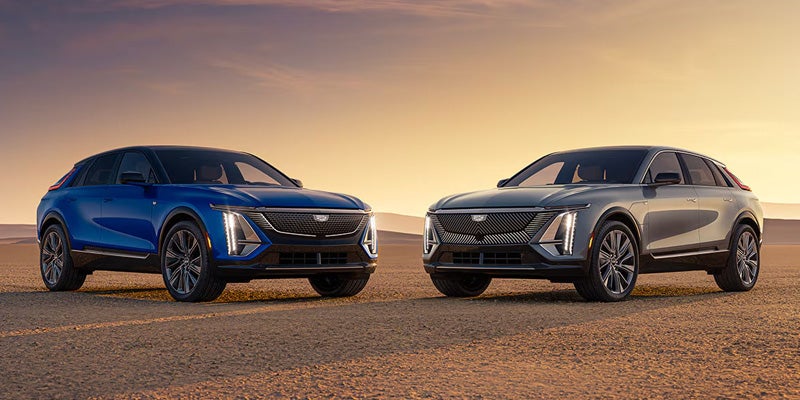



Cadillac has long been a technology innovator, and its latest generation of cars - including the ATS, CT6, Escalade, and XT5 - continue the tradition of giving Cadillac buyers early access to cutting-edge technology. For example, the new 2018 CT6 includes the first operational, Level 2 hands-free driving system available in the U.S. Let's look at some other fantastic inventions that Cadillac has brought to market:
1. Standardized Parts (1908) We all take for granted the fact that cars sharing the same make and model year can exchange parts, making repairs and maintenance a straightforward process. That's thanks to Cadillac in 1908. Confident of its ability to consistently produce a large number of precision-engineered parts, Cadillac entered a parts compatibility test sponsored by the Royal Automobile Club, the only U.S. company brave enough to do so. Five identical 1-cylinder Cadillacs were shipped to England, completely disassembled, and parts from each car were thrown into piles. The challenge was to reassemble 5 Cadillacs from these parts, irrespective of the individual car the part came from.
All five Cadillacs came together flawlessly and worked perfectly, thus winning the competition, scoring Cadillac the Dewar Trophy, and earning the automaker the right to call itself "Standard of the World."
2. The Electric Starter (1911) In the early days of motoring, drivers had to hand-crank their cars to get the engine started, which was extremely dangerous. After a friend of Cadillac's Henry Leland was killed while attempting to hand-crank a car, Leland pledged to do things a better way, and the ultimate result was the industry's first electric starter, which debuted in the 1912 Cadillac model line.
Doing away with the hand crank had the benefit of making car ownership more accessible for people with disabilities and those who simply hated the hassle of hand-cranking. This innovation (again) earned Cadillac the Dewar Trophy for automotive engineering excellence.
3. The SynchroMesh Gearbox (1928) Next to hand-cranking, the biggest hassle likely to mar an early automobilist's journey pertained to gear-shifting. Even after many hours of practice, the simple act of shifting from one gear to the next was likely to cause gear grinding, power loss, and embarrassment. GM's patented SynchroMesh system solved this problem. It first appeared in Cadillacs of the 1928 model year and quickly became ubiquitous across GM's vehicle line.
4. Shatterproof Safety Glass (1928) Early automobile windshields and windows used the same kind of ordinary plate glass used in structures. When the glass broke, sharp fragments went everywhere, often resulting in serious injury to the car's occupants. "Security Plate Glass" was Cadillac's name for the type of shatter-proof glass introduced on all new model Cadillacs and LaSalles for the 1928 model year. This key safety feature quickly made its way across the entire GM product line.
5. Selectable Suspension Ride (1933) Being able to adjust suspension parameters with the touch of a button is a common feature in many new cars today. What's amazing is that Cadillac had this technology in place as early as 1933. Cadillac's system provided for 5 different suspension settings that could be changed by simply moving a small lever positioned to the left of the steering column. Today Cadillac's high-tech adaptive suspension system is called MagneRide: it uses electricity and magnetism to provide a completely optimized ride for every road condition.
6. Power Steering (1954) While Chrysler was the first U.S. automaker to offer power steering as an option, GM was the first to include it as a standard feature in its 1954 line of Cadillacs. GM's original power steering system used hydraulic pressure to assist in steering the wheels. Today, Cadillac's system, branded Magnasteer, uses a magnetic system to provide just the right amount of assist for each speed range.
7. Radar-based Forward Collision Detection (1959) Today's generation of cars sold in the U.S. routinely provide advanced collision detection and prevention technology using radar to forewarn the driver that objects lie ahead or in blind spot zones, and, if necessary, brake the car. Many will be surprised to learn that Cadillac demonstrated a proprietary radar-based forward collision warning system in its 1959 Cyclone XP-74 Concept Car, achieved through two proximity-sensing radar units installed in nose cones mounted to the front of the vehicle.
8. Hands-free Self-Driving Technology (2017) In 2017, Cadillac became the first auto-maker to provide a genuine Level 2 hands-free driving system called Super Cruise. It's an optional feature available to buyers of Cadillac's 2018 CT6. Super Cruise uses 3D mapping technology developed by GeoDigital, a GM subsidiary, along with a unique driver-watching "attention" system ensuring that the human driver remains alert and attentive to what's happening on the road ahead. Several Super Cruise-equipped Cadillac CT6 recently completed coast-to-coast trips without incident. Count on Cadillac to be aggressive advancing the self-driving art in the years to come.
If you'd like to see for yourself how far Cadillac is pushing the innovation envelope, please visit us at Sarant Cadillac's dealership in Farmingdale. We'd love to meet you and provide you a test drive in one of Cadillac's great new cars. Call us at 877-212-1682 or use our website's online contact form.